

 English
  Arabic
  French
  German
  Italian
  Portuguese
  Russian
  Spanish
  Turkish
How GS Housing Is Transforming Hospital and School Buildings With Innovative Steel Solutions
How GS Housing Is Transforming Hospital and School Buildings With Innovative Steel Solutions
Public buildings today face mounting pressure to be safer, delivered faster, and more adaptable. Hospitals must respond to seasonal surges and emergency events. Schools deal with growing class sizes, aging facilities, and tight budgets. Traditional construction often struggles to keep up. This is where steel-based modular building systems from GS Housing are stepping in—helping institutions build smarter without slowing daily operations.
Backed by six large production bases and years of industrial manufacturing experience, GS Housing provides modular buildings built from steel frames, non-combustible wall systems, and pre-finished functional units. These structures are widely used in hospitals, clinics, classrooms, campus dormitories, temporary teaching areas, emergency medical stations, and more.
Why Are Steel-Based Modular Buildings Changing Hospital and School Construction?
The shift toward steel modular construction did not happen overnight. It grew from the need for reliable buildings that can be delivered quickly while maintaining stable quality.
Faster Project Delivery With Factory Precision
Speed matters in public service sectors. Hospitals often require new wards in weeks, not months. Schools may need additional classrooms before a new semester begins. Because the modules arrive ready for assembly, onsite work is greatly reduced. Instead of long wet-trade cycles, teams only handle installation and light connection work. Many institutions use these solutions to expand existing facilities without interrupting daily operations.
Stable Quality Through Industrialized Steel Manufacturing
Another challenge with traditional construction is quality fluctuation. Weather, manpower differences, and site constraints easily affect outcomes. GS Housing’s modular units undergo standardized production with CNC equipment, automated panel lines, and strict QC processes.
This industrial approach delivers repeatable, stable results—especially important for hospitals and schools where safety cannot be compromised.
Flexible Space Planning for Diverse Functional Needs
No two hospitals or schools look exactly alike, yet both require spaces that can change over time. GS Housing’s box units can be joined side-by-side or stacked up to three or four storeys high to create anything from small consultation rooms to large lecture halls, laboratories, dormitories, or school canteens.
Even better, if circumstances change, the same modules can be taken apart, moved to another part of the campus, or shipped to an entirely different location and reused. That kind of adaptability saves huge amounts of money in the long run.
How Modular Steel Systems Make Public Buildings Safer and Far More Durable
Safety always comes first in places where vulnerable people gather every single day.
Fire-Resistant Materials That Actually Stop Flames
GS Housing fills walls and roofs with high-grade rock wool and other completely non-combustible materials. These panels do not feed fires and keep performing even when temperatures soar. In hospitals running oxygen lines or schools packed with excited children, that extra protection can make all the difference.
This is particularly important in hospitals with oxygen equipment and schools where large numbers of young students gather.
High Structural Strength From Steel Frames
Public buildings require structures that stay stable through long use cycles. The modules pass national structural testing and can withstand 8-degree seismic conditions and 12-grade wind loads, making them suitable for urban and remote regions alike.
Long-Term Stability Under High-Frequency Building Use
Hospitals and schools face heavier wear than residential buildings. GS Housing’s modular houses are designed around durability—strong load-bearing columns, reliable waterproofing, robust joints, and impact-resistant internal panels. Many institutions use them as semi-permanent buildings with service lives exceeding 20 years.
What Makes GS Housing’s Modular House Ideal for Modern Hospitals?
Hospitals have strict functional and hygiene requirements. Modular solutions must create clean, sealed environments that support medical workflows.
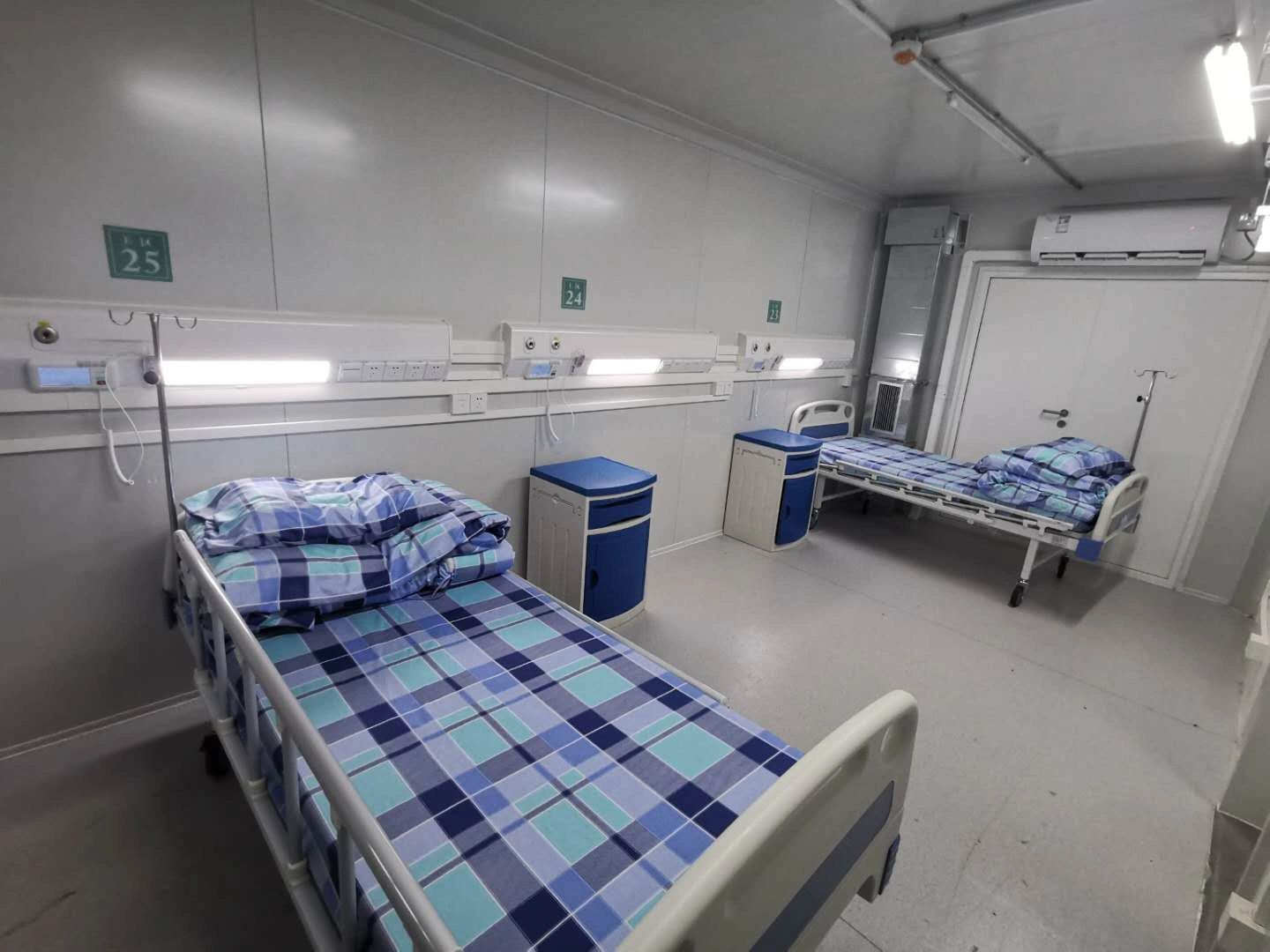
Clean, Enclosed, Pre-Finished Medical Spaces
Because interior finishing is completed in the factory, the modules arrive fully enclosed and dust-free. They include pre-installed flooring, insulated wall panels, concealed wiring, and ready-to-clean surfaces suitable for patient areas, consultation rooms, laboratories, or imaging units.
This controlled process helps hospitals reduce onsite contamination risks.
Rapid Deployment for Emergency or Expansion Needs
In times of sudden medical demand—seasonal outbreaks, regional emergencies, or equipment upgrades—modular buildings can be deployed fast. GS Housing can deliver large numbers of medical-grade units from its nationwide manufacturing bases, supporting rapid setup of temporary wards or additional outpatient spaces.
Integrated MEP Systems Ready for Onsite Connection
Hospital environments depend heavily on mechanical, electrical, and plumbing systems. In GS Housing’s modules, piping, electrical conduits, and HVAC pathways are pre-routed. This reduces onsite errors and shortens commissioning time while keeping the building layout clean and manageable for facility teams.
Why Are GS Housing’s Modular Solutions Ideal for School Environments?
Schools across many regions face growing enrollment and aging buildings. Modular construction offers a practical way to expand teaching facilities without disrupting campus life.
Multi-Functional Classrooms Built From Scalable Modules
From general classrooms to science labs, art rooms, libraries, and administrative offices, the modules can be configured freely. Schools appreciate that they can add units over time, forming larger teaching blocks or multi-story classroom buildings as needed.
Safe and Comfortable Learning Spaces With Sound and Thermal Control
Sound insulation and thermal stability are essential for productive learning. The modular buildings use insulated composite panels and steel-structured airtight design that helps regulate temperature and reduce outside noise—supporting a quieter, more comfortable environment for students.
Cost-Efficient Construction With Minimal Campus Interruption
One major benefit for schools is reduced disturbance. Most work happens offsite, meaning no large wet construction areas, reduced dust, and lower noise. Many campuses install entire classroom blocks during vacation periods, avoiding interference with teaching schedules.
How Do GS Housing’s Modular Solutions Support Sustainability in Public Infrastructure?
Sustainability has become a major priority for public projects, and modular construction fits naturally into this direction.
Reduced Waste Through Controlled Factory Production
Traditional construction generates large amounts of waste. In contrast, factory production allows precise material control and significantly reduces water use, concrete consumption, and debris—GS Housing’s modular method reduces job-site waste by up to 70%.
Efficient Thermal Performance Lowering Energy Use
Good insulation is built into the structure from the beginning. The stable layer of composite wall panels and airtight steel frames helps lower heating and cooling loads over the building’s lifespan.
Reusable Modules Supporting Circular Construction
Steel-framed modular units can be relocated or reused in new projects. Many institutions redeploy older modules as storage rooms, temporary offices, or auxiliary spaces—extending building life cycles and reducing overall resource consumption.
How Can Institutions Start Their Modular Hospital or School Project With GS Housing?
Getting started is simpler than many imagine. Institutions can work directly with GS Housing or through local project partners.
End-to-End Modular Project Consultation
GS Housing helps clarify building needs, site conditions, functional layout, and regulatory issues, proposing a clear project plan and realistic delivery timeline.
Customized Steel Solutions Tailored to Each Building Type
Medical buildings and teaching facilities each have unique requirements. GS Housing works with architects and engineers to refine structural loads, envelope details, interior finishes, and MEP integration to match the intended use.
Global Delivery and Onsite Assembly Support
GS Housing operates six major production bases across China for national distribution and supports global shipping. Onsite teams assist with installation, lifting operations, and commissioning to make sure the modular buildings are ready for use quickly.
Ready to Build Faster, Safer, and Smarter? Contact GS Housing Today
Modular steel buildings offer a practical path for hospitals and schools seeking fast delivery, long-term durability, and cost efficiency. With its advanced production capacity and proven solutions, GS Housing is helping institutions worldwide build secure and comfortable environments for patients, students, and staff.
FAQ
Q1: How long does it take to set up a modular hospital unit?
A: Most projects take significantly less time than traditional construction. Depending on scale, many medical units can be assembled within a few weeks after modules arrive on-site.
Q2: Are modular classrooms as durable as permanent buildings?
A: Yes. GS Housing’s steel structures are tested for high wind and seismic resistance and can be used as long-term or semi-permanent buildings.
Q3: Can modular buildings be upgraded or expanded later?
A: Definitely. Modules can be added, reconfigured, or relocated, making them practical for growing schools or hospitals expecting future expansions.



