Russian
  English
  Arabic
  French
  German
  Italian
  Portuguese
  Spanish
  Turkish
Новости отрасли
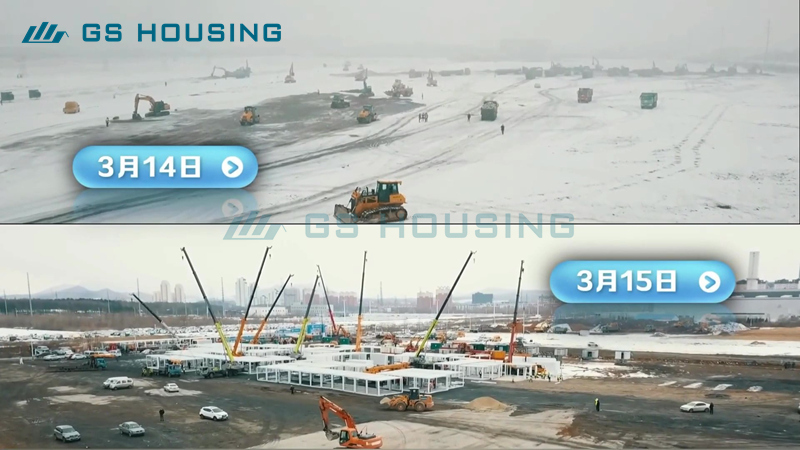
Помощь в случае стихийных бедствий за часы, а не дни: решение GS Housing Emergency Container
Container House vs Traditional Building: Which Is Better for Worker Accommodation and Project Camps?
Container House vs Traditional Building: Which Is Better for Worker Accommodation and Project Camps?
2026-01-22 10:14:26
Meta Description
When project owners compare container houses with traditional buildings, it is rarely a theoretical discussion.
It usually begins on site—when schedules slip, labor arrives early, or temporary housing becomes an urgent operational issue.
This article compares container houses vs traditional buildings from a project owner’s perspective, focusing on worker accommodation, construction camps, cost control, speed, and on-site predictability.
Rather than design theory, it looks at how each option performs under real project pressure—where time, location, and changing requirements matter more than drawings.
Container House vs Traditional Building: Speed and On-Site Time Control
On paper, traditional construction follows a familiar order: foundation, structure, enclosure, MEP, finishing.
On site, things rarely unfold that neatly.
Materials arrive late. Inspections slow things down. Labor schedules don’t align. Meanwhile, workers are already on payroll, and every unproductive day quietly eats into the budget.
This is often the moment when project teams start looking for housing solutions that can move faster. Not because container houses are exciting or new, but because they’re already built.
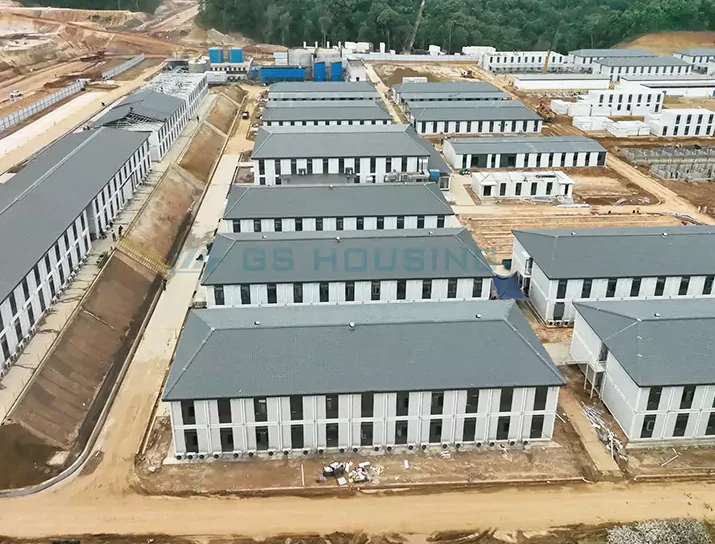
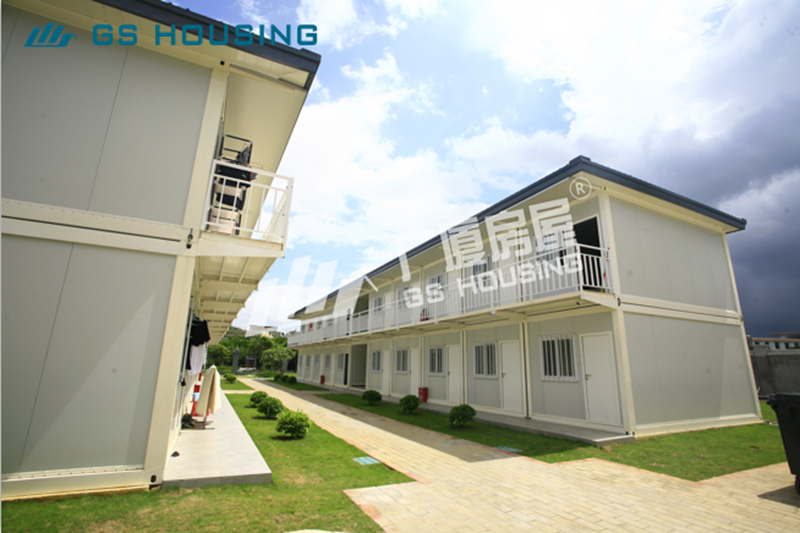
With modular container housing, most of the work happens in a factory before anything reaches site. The steel frame is finished. Insulation is installed. Wiring, plumbing, windows, even interior finishes are already in place. When the units arrive, it feels less like construction and more like setting things into position.
For project owners under time pressure, that shift is important. It moves uncertainty away from the site and into a controlled manufacturing environment—where fewer things are left to chance.
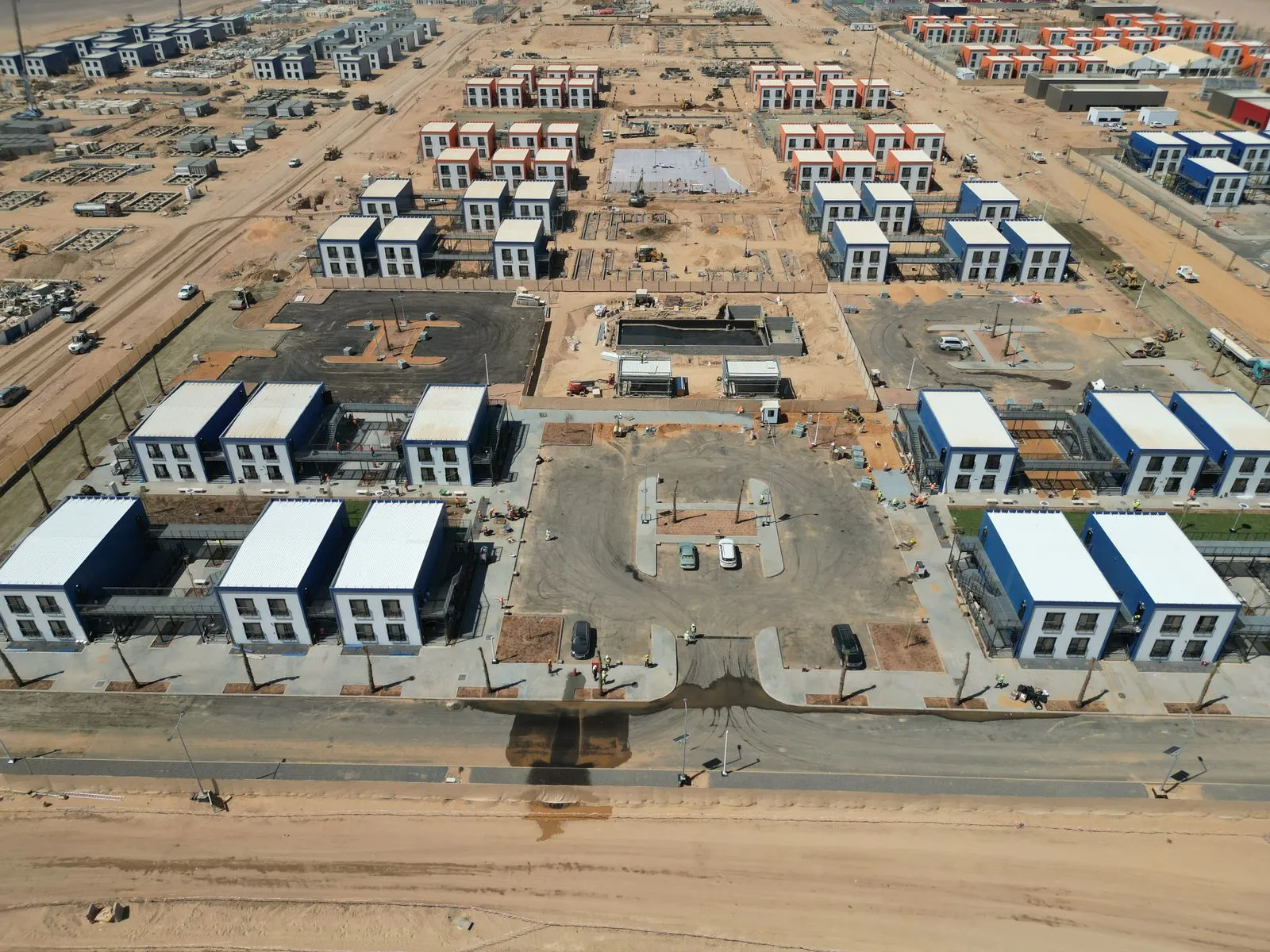
The difference between theory and reality became very clear on a large worker accommodation project along Saudi Arabia’s Red Sea coast, designed to house more than 2,500 people.
This industrial infrastructure project required fast deployment, predictable performance, and minimal on-site rework under extreme climate conditions.
This was not an easy site.
Daytime heat was intense. UV exposure was constant. Fine sand found its way into everything. Nights cooled down quickly, which meant materials expanded during the day and contracted after sunset.
The real concern wasn’t just speed—it was what would still be working six months later.
Traditional temporary buildings would have struggled here. Seals dry out. Panels warp. Maintenance becomes a daily job. So instead, the project team leaned toward steel-structure container houses that could be fully controlled before delivery.
Insulation levels were increased to handle the heat swings. Exterior panels were selected specifically for UV resistance. Sealing details were reinforced to keep sand out. Roof designs were adjusted to reduce heat buildup rather than just shed water.
None of these decisions were made on site. They were locked in at the factory stage. Once the units arrived, there was very little improvisation—by design.
That’s what made the difference. The housing didn’t just go up quickly; it behaved predictably in an environment that usually punishes shortcuts.
Layouts followed principles similar to those shown in GS Housing’s modular camp projects:
The Cost Question (And Why It Rarely Feels Simple)
Early on, most conversations sound the same:
“Which option is cheaper?”
After a few projects, the question usually changes to:
“Which option is going to surprise us less?”
Traditional construction hides cost in time. Extra supervision. Idle labor. Rework. Small delays that don’t look serious until they stack up. On paper, the numbers may look reasonable. On site, they tend to drift.
Prefab container housing works differently. Most decisions are made early. Specifications are clear. Prices are easier to pin down. Changes still happen, but at least you know what they cost before you approve them.
Depending on location and specification, prefab container house costs often come in 10–30% lower than comparable temporary traditional buildings. But for many project owners, the real benefit isn’t the percentage—it’s knowing what the final number is likely to be.
Manufacturers like GS Жилище operate their own container house factories, which means steel fabrication, insulation, and testing stay under one roof. That level of control doesn’t eliminate problems, but it reduces the kind of last-minute adjustments that quietly drain budgets.
It’s not about saving every dollar.
It’s about avoiding the slow leaks.
How to handle changes mid-project?
If you’ve worked on real projects, you already know the answer: things change.
More workers arrive than expected.
What started as dormitories suddenly needs offices.
A temporary camp needs to stay another year.
Traditional buildings don’t handle this well. Walls are in the wrong place. Services don’t line up. Every change feels heavier than it should.
Container housing is easier to live with when plans shift. Need more rooms? Add units. Need offices instead of beds? Reconfigure the layout. When the project moves, the buildings can move too.
That flexibility isn’t a marketing feature—it’s a relief. Especially when decisions are made under pressure.
Systems like GS Housing’s prefabricated housing solutions use the same structural logic for dormitories, offices, dining halls, and support spaces. When requirements change, you’re adjusting pieces of a system, not starting over.
Transportation: The Part Everyone Underestimates
In design meetings, people talk about layouts and elevations.
On site, people talk about roads.
Traditional construction depends on constant deliveries—cement, steel, blocks, sand. On remote sites, every delivery is a potential delay.
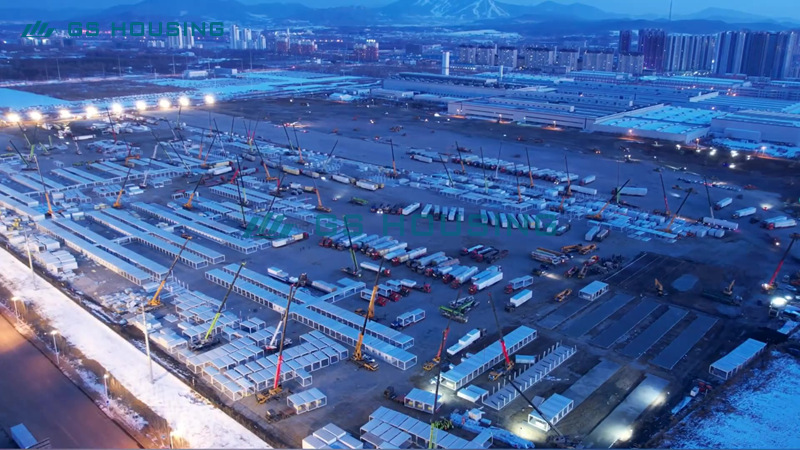
Container housing arrives in batches. The units are lifted into place, connected, and that part of the job is done. Fewer trucks. Fewer dependencies. Fewer chances for something to go wrong.
That’s why container camps show up so often in mining projects, desert infrastructure work, coastal developments, and island construction. Not because someone prefers containers—but because they travel better than bricks.
Many overseas projects supplied by GS Housing reflect this reality. Logistics isn’t an afterthought. It’s part of the design.
When Each Option Actually Makes Sense
Container houses are not meant to replace traditional construction everywhere.
They work best for:
Worker accommodation
Project offices
Temporary or phased construction camps
Emergency or remote housing
They are less suitable for:
High-end residential projects
Permanent urban buildings
Architecture-driven landmark developments
Traditional buildings still matter. The mistake isn’t choosing one over the other. The mistake is forcing a solution into conditions it wasn’t designed for.
So… Container House or Traditional Building?
If your project is stable, long-term, and running on a comfortable schedule, traditional construction can work just fine.
If the timeline is tight, the location is challenging, or the scope might change, container housing often feels safer—not because it’s cheaper or better looking, but because it behaves more predictably once things get moving.
For project owners evaluating container houses vs traditional buildings, the right choice depends less on preference and more on site conditions, timelines, and long-term project risk.
Discussing structure, insulation standards, logistics, and expansion scenarios early often prevents costly adjustments later.
If you want to evaluate which option fits your project conditions, GS Housing’s technical team can provide practical input based on real worker accommodation and construction camp projects.